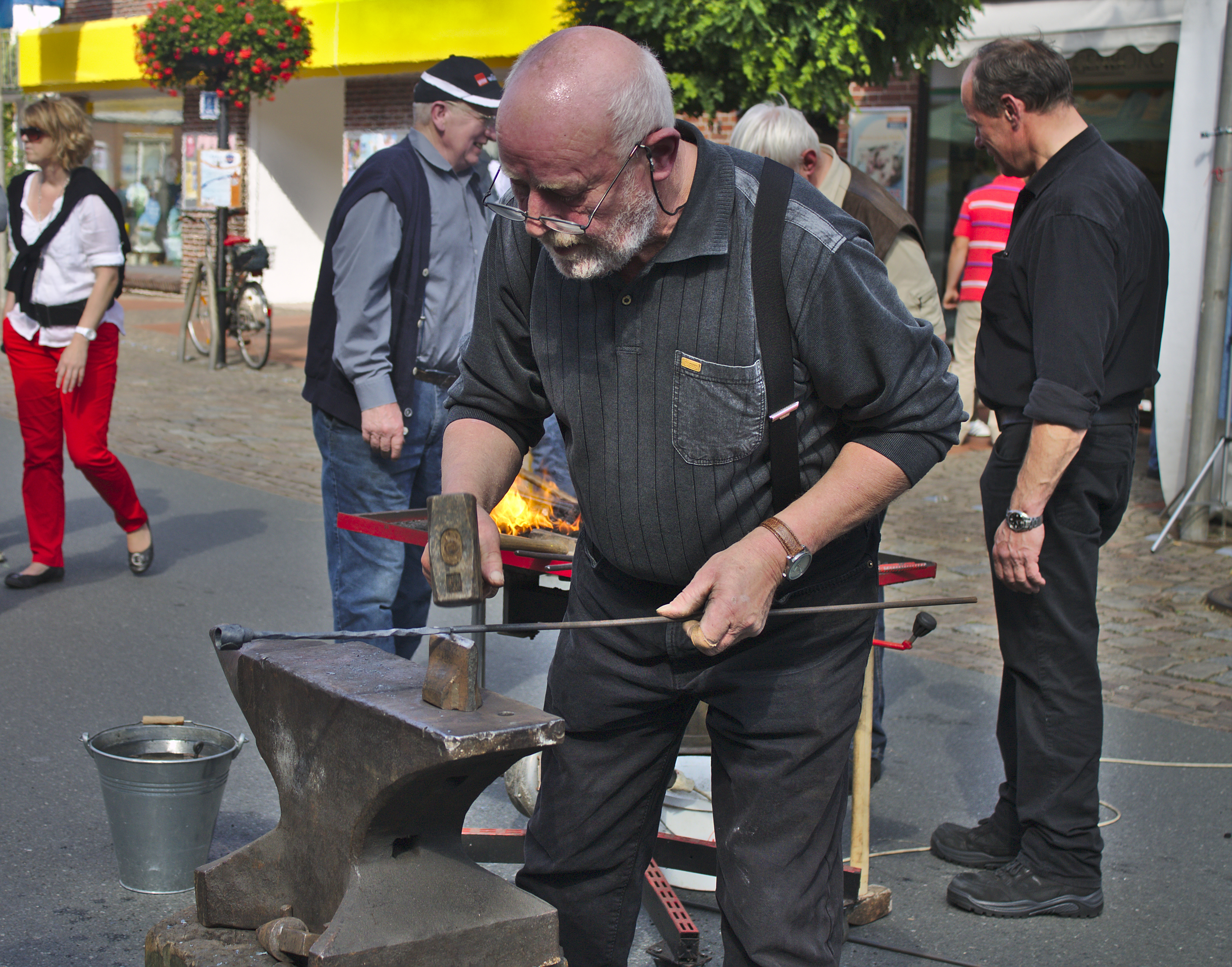
Blacksmithing is temperature-dependent work. Every forging operation has an effective heat range — too cold and the metal cracks or work-hardens before the shape is reached; too hot and it burns, becoming granular and brittle. For mild steel and wrought iron, the orange-to-yellow heat range (roughly 900–1150 °C) covers most general forging. High-carbon steel is worked at a slightly lower range to avoid burning out carbon content.
The five techniques described here represent the entire vocabulary of hand forging. Virtually every object a blacksmith produces — a hook, a hinge, a knife blade, a decorative scroll — is made through some combination of these operations.
Drawing Out
Drawing out elongates a piece of stock by reducing its cross-section. When you strike the top surface of a bar with the peen of a cross-peen hammer — or angle the flat face slightly — metal flows perpendicular to the blow, increasing length and reducing width or thickness.
The technique for drawing out efficiently involves working in overlapping blow sequences rather than hitting the same spot repeatedly. A smith draws from the far end of the section back toward the tong grip, rotating the bar 90 degrees between passes to keep the cross-section uniform. After several heats of peen work, a finishing pass with the flat face of the hammer smooths the surface.
Practical note: Drawing a 20 mm square bar down to a 10 mm round taper typically requires two to four heats depending on the length of the taper and the weight of the hammer. Attempting to do this in a single heat by working the metal past its lower forging threshold produces a cold-shut — a fold in the surface that weakens the finished piece.
Upsetting
Upsetting is the opposite of drawing out: metal is compressed to increase cross-sectional area and reduce length. The bar is heated, stood on end on the anvil face, and struck from above. The hot section mushrooms outward. Alternatively, the bar can be held horizontally and the end struck against the anvil face.
Upsetting is used to form bolt heads, widen the end of a bar before punching a hole (so the metal around the hole has sufficient thickness), and create shoulders that stop another piece from sliding along a rod. It is physically demanding because the resistance of the metal works against the direction of movement — unlike drawing out, where the metal yields easily in the direction of flow.
Bending
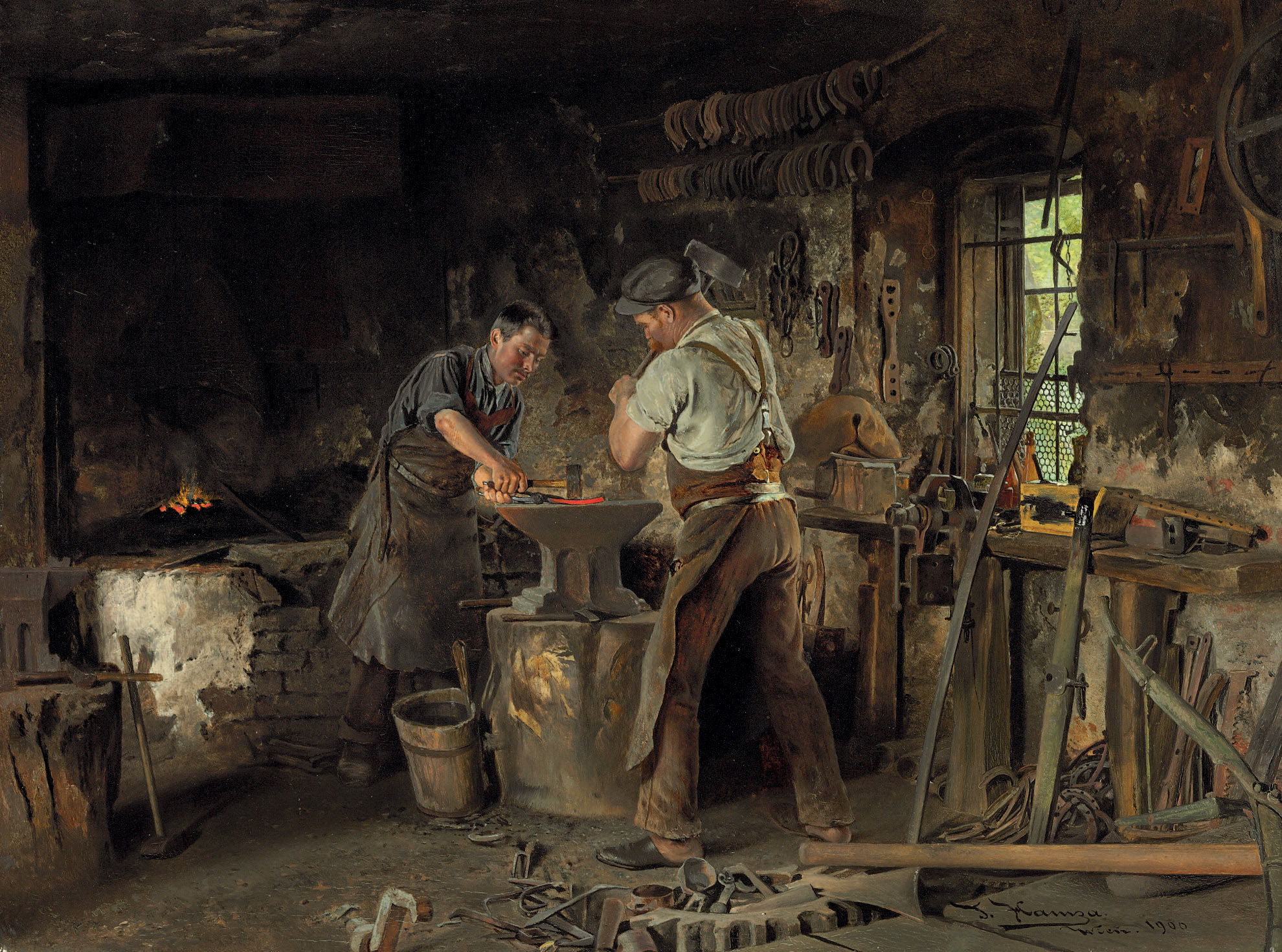
Bending requires the metal to be hot only at the point of the bend. A sharp bend is made over the edge of the anvil face or the horn; a gradual curve is worked progressively over the horn, moving the bar with each blow.
There are two problems specific to bending that the smith must manage:
- Cross-section distortion: Bending a bar tends to spread it at the bend point, reducing height. The smith corrects this by re-forging the distorted section back to the original cross-section before the piece cools.
- Length change: All bends shorten the effective length of the workpiece because the neutral axis of the bend is inside the outer radius. For tight-tolerance parts, this is accounted for in the length of the starting stock.
Punching and Drifting
Punching creates a hole in the work by displacing rather than removing metal. A hot punch (a tapered tool of hardened steel) is driven partway through the work at forging temperature, then the piece is flipped over and the punch is driven back through from the other side to eject the slug.
The sequence matters: driving entirely through from one side creates a tapered hole rather than a uniform one, and it strains the metal unevenly. The correct method — halfway from one side, flip, complete from the other — produces a more uniform hole with less distortion of the surrounding area.
After punching, a drift (a round or square tapered rod) is driven through the hole while it is still at working temperature to size it accurately and refine its shape. Drifts for hammer eyes are oval, following the profile of a hammer handle; drifts for chain links are round.
| Operation | Heat Required | Tool Used | Result |
|---|---|---|---|
| Drawing out | Orange–yellow (900–1150 °C) | Cross-peen hammer, flat hammer | Increased length, reduced section |
| Upsetting | Orange (900–1050 °C) | Flat hammer, anvil face | Increased section, reduced length |
| Bending | Orange at bend point only | Anvil edge, horn, bending fork | Angular or curved form |
| Punching | Yellow–white (1050–1200 °C) | Hot punch, pritchel hole | Displaced-metal hole |
| Fire-welding | White (1200–1300 °C) | Flat hammer (light rapid blows) | Two pieces joined without fasteners |
Fire-Welding
Fire-welding (forge welding) joins two pieces of iron or steel by heating them to near their melting point and hammering them together before they cool. At welding heat the metal is incandescent white, and the surface has a liquid sheen. The smith withdraws both pieces, places them together on the anvil, and strikes with moderate, rapid blows — the goal being to force the surfaces into contact without moving the pieces laterally, which would smear the weld rather than consolidate it.
Traditional fire-welding used a flux — typically borax or a mix of borax and sand — applied to the joint area before the final heat. The flux melts at welding heat, flows over the surface, and excludes oxygen, preventing the scale (iron oxide) that would otherwise prevent a clean bond. Without flux, the scale layer between the two pieces acts as a barrier and the weld fails.
Wrought iron fire-welds more readily than mild steel, and considerably more readily than high-carbon steel. This is why traditional pattern-welded blades — made by welding alternating layers of different carbon-content steels — required skilled temperature management to prevent the higher-carbon layers from burning before the lower-carbon layers reached welding heat.

Reading Heat Colour
Before pyrometers were available in small shops, smiths judged temperature by the colour of the metal. The colour sequence as iron heats is consistent enough that an experienced smith can read it in ambient light:
- Black heat — not yet visible, below 400 °C. Metal will air-harden; do not hammer.
- Black red — barely visible glow, around 450–600 °C.
- Dark red — 600–750 °C. Metal can be bent if necessary but not efficiently forged.
- Cherry red — 750–900 °C. Suitable for twisting and light bends.
- Orange — 900–1050 °C. General forging range for mild steel.
- Yellow-orange — 1050–1150 °C. Free-working range; drawing and punching.
- White — 1150–1300 °C. Welding heat. Metal is near-liquid at surface.
These colour references assume subdued interior lighting. In direct sunlight the colours wash out, and the practical upper bound becomes harder to distinguish — a common source of burning metal in outdoor demonstrations.
References
- Bealer, Alex W. The Art of Blacksmithing. New York: Funk & Wagnalls, 1969.
- Hrisoulas, Jim. The Complete Bladesmith. Boulder, CO: Paladin Press, 1987.
- McRaven, Charles. Country Blacksmithing. New York: Harper & Row, 1981.
- Wikimedia Commons. commons.wikimedia.org — image sources.